
cropper
update
Drone Central Station
update
  • Home
  • Categories
    • Drone Tech
    • Drone Applications
    • Drone Racing
    • Accessories
    • Real Estate
    • Military
    • Disaster
    • Drone Footage
    • Product Reviews
    • Business Profiles
August 21.2025
2 Minutes Read

AeroVironment's P550 Drone Delivery Enhances Military Drone Technology

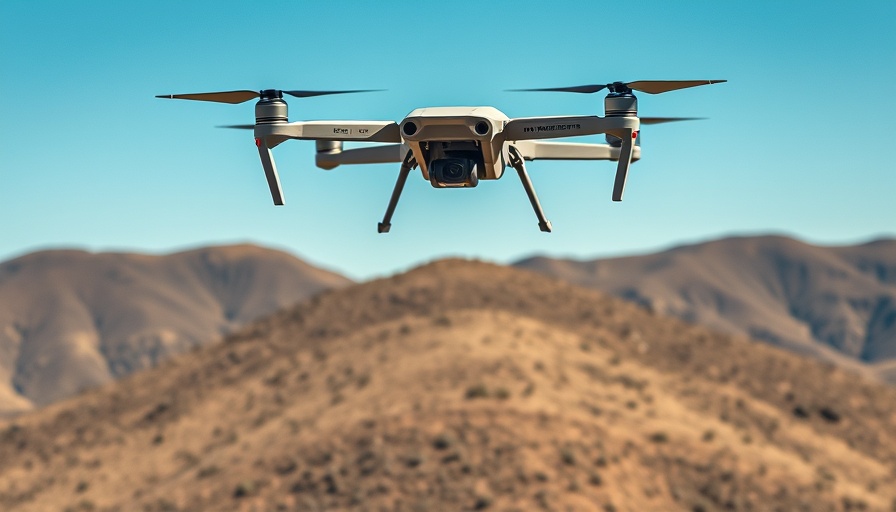
AeroVironment P550 drone flying over hills.

The Embracing of Advanced Drone Technology in Military Operations

AeroVironment's recent delivery of the Group 2 P550 autonomous eVTOL UAS to the U.S. Army has ignited discussions on the strategic significance of unmanned systems in modern warfare. The P550 not only represents a technical achievement but also highlights a major shift in how military forces are rethinking their operational strategies in light of evolving threats. With its advanced operational capabilities, the P550 showcases the trend of integrating cutting-edge technology in military applications.

Why the P550 Matters for Enhanced Situational Awareness

The P550 is designed with a Modular Open Systems Approach (MOSA), enabling it to rapidly adapt to ever-changing battlefield scenarios. This is crucial in today’s environment where wars are often fought with speed and intelligence. As military operations increasingly rely on real-time data for decision-making, systems like the P550 that provide superior situational awareness through AI and advanced sensors become indispensable.

The P550's Impact on Military Training and Efficiency

Alongside the delivery of the P550 systems, AeroVironment also provided comprehensive new equipment training, a step that underscores the importance of preparedness. The implementation of a “train-the-trainer” model means that units can quickly assimilate this drone technology into their operational protocols, enhancing readiness across the board. This approach aligns with ongoing initiatives to streamline military operations in the face of tight timelines and resource constraints.

A Future-Proof Solution in Unmanned Aerial Systems

The P550 stands out not just for its immediate capabilities but also for its potential longevity in service. With a payload capacity of up to 15 pounds and a gross take-off weight of 55 pounds, it’s engineered for flexibility—fields like reconnaissance, surveillance, and direct targeting operations. For military planners, the P550 is an investment that promises to keep pace with technological advances due to its open architecture.

Beyond the Battlefield: The P550's Broader Applications

While primarily aimed at military use, the technologies underpinning the P550 could eventually see adaptations in civilian applications, such as disaster response and search and rescue missions. The versatility and reliability exhibited by such drones are attractive to both military and non-military stakeholders, signaling a future where drones play an integral role across various sectors.

In summary, the delivery of the P550 systems marks a pivotal moment for the U.S. Army and military operations globally. As these technologies continue to evolve, they fundamentally reshape not just arms and tactics, but also how we envision modern warfare.

To learn more about the intersection of technology and military strategy, stay informed on emerging advancements that will shape our future. Explore the potential of unmanned systems in operations and consider how they might affect industries beyond defense.

Military

41 Views

0 Comments

Write A Comment

*
*
Please complete the captcha to submit your comment.
Related Posts All Posts
04.24.2026

Greek Navy Welcomes CAMCOPTER S-100: A Leap in Naval Drone Technology

Update Schiebel’s Breakthrough with the Greek Navy In a significant advancement for naval technology, Schiebel has completed the first acceptance milestone for the CAMCOPTER S-100 unmanned air systems (UAS) intended for the Greek Navy's new Frégate de Défense et d’Intervention (FDI) frigates. This milestone comes after the signing of a contract in February 2026, which marks a commitment to enhancing Greece's maritime capabilities. The successful completion of acceptance tests for the first two systems at the Kotroni Helicopter Base reflects the ongoing modernization efforts within the Greek naval forces. Capabilities and Mission Readiness Equipped with state-of-the-art L3 Harris MX-10 electro-optical infrared (EO/IR) sensors and Overwatch Imaging PT-8DN Oceanwatch capabilities, the CAMCOPTER S-100 is designed for a variety of missions. These include maritime security, search and rescue operations, environmental monitoring, and surveillance of the country's exclusive economic zone (EEZ). With the successful completion of a week-long testing schedule, these systems demonstrate their readiness for operational deployment, a critical step for the Hellenic Navy in enhancing national security. Technological Advancements in Military Operations The integration of advanced unmanned systems into naval operations represents a trend that is increasingly defining modern military strategy. As seen in other recent contracts awarded globally, such as Lockheed Martin's deal to enhance U.S. Navy air defense systems, the focus is shifting toward more unmanned and automated solutions. The successful testing of the CAMCOPTER S-100 not only indicates Schiebel's commitment to innovation but also aligns with broader military trends emphasizing adaptive and responsive maritime strategies. The Significance of This Collaboration Hans Georg Schiebel, the Chairman of Schiebel Group, emphasized the importance of this milestone, stating, "The successful acceptance campaign highlights the effective collaboration between Schiebel and the Hellenic Navy, paving the way for operational deployment." This collaboration is indicative of a growing trust in advanced technological partnerships between defense companies and national militaries. Such partnerships are vital for countries looking to enhance their defense capabilities amidst evolving geopolitical landscapes. Comparative Insights: A Global Perspective A comparative analysis reveals a wider context in which countries are prioritizing investment in unmanned systems. For instance, other European nations have similarly expanded their naval capabilities by adopting cutting-edge technologies that integrate drones into their fleets. As countries like Greece seek to bolster their security through technological advancements, the implications for regional security dynamics can be significant. Future Opportunities and Predictions Looking ahead, the introduction of the CAMCOPTER S-100 into the Greek Navy represents not only immediate operational capabilities but also sets a precedent for future innovations in unmanned naval operations. As technology continues to evolve, we can expect enhancements in autonomous flight capabilities, longer operational ranges, and improved data analytics for real-time decision-making in maritime environments. This could lead to more agile naval operations capable of responding swiftly to emerging threats. Conclusion: Towards a Modern Naval Force The completion of the acceptance tests for the CAMCOPTER S-100 marks a pivotal moment for the Hellenic Navy as it modernizes its fleet. With the successful integration of unmanned systems, Greece is poised to enhance its maritime capabilities significantly. For those interested in the future of military technology and operations, this development is a clear signal of the direction in which global defense strategies are heading.

04.23.2026

Unveiling Ukraine's Advanced Arsenal: How Technology is Redefining Military Power

Update Ukraine's Defense Technology Revolution: A Game Changer in Military Strategy President Volodymyr Zelenskyy's recent video address marking Ukraine's Arms Makers’ Day was more than just a celebration; it was a powerful demonstration of the country's rapid military transformation. Showcasing an arsenal of 56 domestically developed weapons systems, including an impressive array of 31 drones, seven missiles, and an assortment of robotic and naval platforms, Ukraine has proved its resilience and innovative spirit in defense technologies. This showcase illustrates how Ukraine's military has evolved significantly since the onset of conflict, enabling a more robust defense strategy. The Arsenal: A Closer Look at Advanced Ukrainian Weapons Among the showcased weaponry, the long-range Flamingo missile stands out, capable of striking targets up to 3,000 kilometers away and designed for strategic warfare. The Flamingo, alongside other advanced missile systems like the Ruta and Peklo, emphasizes Ukraine's focus on developing precision strikes to effectively counter threats. Drones have also emerged as a pivotal element in this arsenal, with the Sichen and Liutyi kamikaze drones leading the charge. Their long operational ranges of 1,400 and 2,000 kilometers respectively demonstrate Ukraine's commitment to maintaining an edge in aerial combat. Robotics in Warfare: Transforming Combat Dynamics Ukrainian ground robotic systems are redefining battlefield strategies, having performed over 22,000 missions on the frontlines in just three months. These unmanned platforms, such as the RATEL H and TerMIT, serve critical roles in logistics, casualty evacuation, and fire support, underscoring their growing significance in modern warfare. This development highlights a strategic shift where human soldiers are supplemented—or even replaced—by robotic systems capable of carrying out complex operations with reduced risk. Naval Innovations: Securing Maritime Operations Ukraine’s naval capabilities are evolving as well, with systems like the Sea Baby and Magura V5 drones marking significant advancements for maritime security. The Magura V5 has even been recognized for sinking a warship, an unprecedented achievement that illustrates the tactical advantages provided by drone technology in naval environments. This evolution emphasizes how Ukraine is adapting to multifaceted threats from adversaries both on land and at sea. International Collaboration and Future Trajectories Zelenskyy's address also emphasized shifting from a focus on internal defense to establishing long-term security partnerships with other nations. By showcasing Ukraine's capabilities, he aims to attract interest in collaborative defense initiatives, reinforcing a network of mutual support that could enhance Ukraine's international standing. As evidenced by ongoing dialogues with Middle Eastern countries regarding military partnerships, this strategic repositioning suggests that Ukraine is not merely defending its territory but is actively engaging on the global stage. Concluding Thoughts: The Path Forward The unveiling of over 50 types of weaponry not only highlights Ukraine’s advancements in military technology but signals a significant shift in warfare dynamics. As the conflict continues to evolve, Ukraine's focus on harnessing innovative, cutting-edge technologies will play a crucial role in its defense strategy. Keeping abreast of these developments is essential for understanding the broader implications for both regional and global security in the coming years.

04.23.2026

The LOCUST Laser Weapon System: A New Era for Naval Defense Technology

Update Navigating the Future of Warfare: The LOCUST Laser Weapon System AeroVironment, Inc. has taken a significant step in modern military technology with the demonstration of its palletized LOCUST Laser Weapon System (LWS) aboard the USS George H.W. Bush (CVN-77). This test, conducted in collaboration with the U.S. Navy and the U.S. Army Rapid Capabilities and Critical Technologies Office (RCCTO), marks a milestone in the deployment of directed energy weapons on naval platforms. The successful live-fire event showcased the LOCUST system's capability to detect, track, and neutralize multiple target drones, a promising advancement in counter-drone technology. Understanding LOCUST’s Capabilities and Flexibility One of the standout features of the LOCUST LWS is its platform agnosticism. Designed to operate seamlessly across various platforms—from ground vehicles like the Joint Light Tactical Vehicle (JLTV) to maritime vessels—the system exhibits a remarkable adaptability to different military contexts. John Garrity, AeroVironment's Vice President of Directed Energy Systems, emphasized its game-changing role by stating, "LOCUST delivers effective, all-domain protection against emerging drone threats at the speed of light—on any platform, in any domain, for any mission." This adaptability not only increases operational flexibility but also enhances the Navy's defense posture without necessitating extensive ship modifications. The Importance of Precision and Energy Efficiency Lasers, such as those utilized in the LOCUST system, provide a high degree of accuracy and efficiency. Unlike traditional munitions, which have a defined scope and impact, laser systems operate with virtually unlimited engagement potential as long as power is available. This characteristic allows for the defense against numerous drone threats rapidly—an essential capability given the projected increase in uncrewed aerial systems in contemporary warfare. The LOCUST system can recharge its batteries while connected to the ship's power supply, creating a logistic advantage and reducing the need for extensive ammunition storage. Military Significance: A Turning Point in Defense Technology The demonstration aboard the USS George H.W. Bush is more than just a test; it highlights a significant pivot toward reliance on directed energy solutions within the Navy. Chief of Naval Operations Adm. Daryl Caudle has expressed his vision for directed energy weapons to become the primary defense against close-in threats. This capability not only enhances national security but also positions U.S. military forces at the forefront of modern warfare technology. Challenges and Future Predictions for Laser Systems Despite the promising developments, the deployment of directed energy weapons like the LOCUST system comes with challenges. The effectiveness of laser systems can diminish over distance and be affected by atmospheric conditions, which poses specific operational hurdles. Moreover, maintaining laser systems aboard ships introduces issues of reliability under harsh maritime conditions. Nevertheless, the Navy’s willingness to invest in these technologies suggests a commitment to overcoming these challenges, indicating that future advancements in laser power and reliability may reshape naval defense strategies. As technological advancements continue, the potential applications of LOCUST could expand beyond counter-drone operations, potentially fending off a spectrum of aerial threats. The increased integration of artificial intelligence and machine learning could enhance the decision-making capabilities of these systems, ensuring a faster response to threats and allowing for a proactive defense strategy. Conclusion: The Call for Enhanced Counter-Drone Defenses The successful demonstration of the LOCUST Laser Weapon System aboard the USS George H.W. Bush underscores a transformative moment in military technology. As threats evolve, so must our defense capabilities. Engaging with these developments not only highlights the Navy’s strategic adaptation but also invites industry professionals and technology enthusiasts to consider their prospective roles in shaping future innovations in military technology. Joint conversations surrounding the implementation and expansion of such systems could provide invaluable insights into the national security landscape and how best to protect our forces.

Terms of Service

Privacy Policy

Core Modal Title

Sorry, no results found

You Might Find These Articles Interesting

T
Please Check Your Email
We Will Be Following Up Shortly
*
*
*